Related Posts Plugin for WordPress, Blogger...
Showing posts with label writing. Show all posts

Thursday, October 17, 2019

[write club] Using Music to get into the mood for NaNoWriMo

I've been playing with the idea of a playlist or song to get me into the NaNowriMo "mood". 

When I was young and did annual dancing concerts, the dance school would play a song as a lead in to the start of the concert. Back then it was Neil Diamond "Crunchy Granola Suite", quite a long song. Everyone back stage knew that once that song started they would have 4 minutes to get onto the stage for the first performance. Every time I listen to Crunchy Granola I have flashbacks to leotards and tap shoes.

When I started thinking of songs for NaNoWriMo, I automatically thought of Elvis Costello's "Everyday I write the book" or The Beatles "Paperback Writer".


The song has to be uplifting or perhaps well suited to the genre that you are writing about.
For example: If you were writing a Murder Mystery you might have "Maxwell's Silver Hammer" on your playlist.  I love this remake of "Maxwell's Silver Hammer" by Mona Lisa Twins.


Dive down the rabbit hole and find a song that gives you a pep in your step for NaNoWriMo!

Thursday, September 5, 2019

Melbourne Writers Festival 2019 [Schools Edition]

It has been a few years since I have attended the Melbourne Writers Festival. This year we took a group of girls from both the Write Club and the Book Club into city.

Getting our bookshop fix on at Readings at the State Library.

Do Something About It

The Year 9-12 girls joined me for this panel session talking about how to be an advocate and how to write about advocacy. On our panel was three wonderful women; writer Laniyuk, poet Elena Gomez and writer and critic Sonia Nair.

The group explored their individual motivations on writing, how to be an accessibility advocate (or an accomplice) and how to use social media to "do something about it". Our girls were taken with the idea of an "accomplice" and how they might be able to advocate for causes that are important to them. There was talk about the importance of solidarity and that it involves a lot of listening and learning before taking action. In a culture with information and compassion fatigue; how do we cut through all of that to make our voices heard?

Goodbye, World

Our second session required some travel between Treasury Place and the State Library and we were overjoyed to find out that the speaker of this session Lynette Noni had taken out the 2019 Gold Inky Award last night for her book 'Whisper'.

Meeting back up with the rest of the group, this talk was all about Young Adult novels; the writing process, where to find inspiration and how to weave the story. Lynette spoke passionately about the world that she had created in the 'Medoran Chronicles' and how her characters were her best friends. From how to work out character names to techniques in plotting she kept the group engaged for the 45 minutes and we kept on talking about ideas that she generated for the rest of the afternoon.

Next Year?

Even though the Melbourne Writers Festival School's Program runs all day, we found that just the two sessions worked well with our students. Enough to get ideas from but not too much to exhaust us. The debrief in the Learning Commons when we got back to school was enlightening and hopefully a few of them have some ideas about where to take their writing.

Monday, August 20, 2018

5 useful resources for World Building for your Write Club

Every Monday lunchtime we have a "write club" that meets to talk about how to improve our writing. Lately, we have been looking at "World Building".


1. An Introduction to World Building

This article is a worthwhile read and also links to a podcast of the article. The website also has some excellent resources to build depth into your characters and develop effective plot arcs. Check out the site, there is a lot of material and resources to keep you entertained!

2. The Worldbuilders Anvil

Another fabulous podcasting site with many topics ranging from  from How to build a fantasy car to Worldbuilding cartography. I love podcasts for the ease in which I can listen to them driving to and from work, or if you are a student walking the dog or catching the bus

3. Story setting ideas: 6 effective setting examples and tips 

Now Novel have a great blog post on Story setting ideas. They take examples from well known writers such as Rowling, Dicken's and Tolkien. The author uses the example to show techniques in writing and how you can use this technique in your own writing.

4.  World Building Basic Worksheet

North by Northwest have put together a World Building Basic Worksheet that you can use as a skeleton to craft your own world. Cut and paste this into a google docs and add ideas to it when you want to work on your world.

5. Katytastic

This youtube channel has some great video’s on how to write your world and build your characters.  Most of her video's are about 10 minutes long and an ideal watch if you want something quick to inspire you to continue to write. Most of the video's also have useful links to follow-up on.

Monday, August 6, 2018

A practical guide to setting up a coding club in your School Library

I was excited when I was asked to present at Edutech 2018 on Coding in Libraries as part of the Future Libraries Congress.

The experience was rich and broadened my professional horizons. I spent hours preparing for the event, so when the editor of WASLA contacted me and asked me to write an article for their journal, I jumped at the challenge.


So here is the link to my article, I'd love some feedback. My writing evolves with every article and I enjoy the process and the rigour that is involved.

I hope you enjoy the read.
Lawson, M. (2018). A practical guide to setting up a Coding Club in your School Library. IC3. Professional Journal Of The WA School Library Association, 8(No.2 July), 13-15. (link)

Wednesday, August 5, 2015

I got published!

I enjoy writing! 

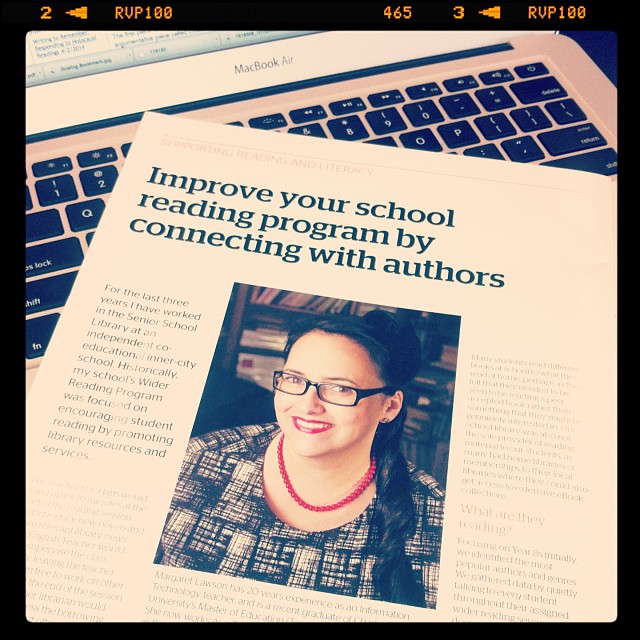
So when the opportunity came up to write for the School Library Association of NSW at the end of last year I jumped at the chance. Lyn Hay was wonderful in allowing this very *new* Teacher Librarian to write down her thoughts about engaging students with author visits.


My article was published at the start of this year and I was very excited when I got my own copy through the mail. In preparation, a good friend took some "author photo's" for me (glamorous from the waist up) and some close friends did some proof reading for me.

My article spoke about my experiences with a number of author visits; Michael Pryor, George Ivanoff and James Phelan. In particular, I reflected on how we felt the impact of the author visit years after the fact. With Year 10 students still borrowing Michael Pryor books years after the visit, because they can remember the "burning book" trick.

This poses the question, are author visits essential to creating an engaged reading culture in schools?

Feedback has been very good and I am looking forward to writing more articles in the future if given the opportunity.

The reference for my article is in the publications page on my blog. If you are interested in my writing or you would like me to expand any of my blog entries into "articles" then please contact me via my blog, twitter or email.

Wednesday, June 24, 2015

Using Playfic to write interactive fiction

During my university years, I played MUD's with a number of friends. As we sat in the vax lab at Uni the adventures were rich and satisfying. I was surprised to find out that these interactive text environments are still being used, not for games, but for interactive fiction.

Playfic is a platform using Inform for writing and playing interactive fiction. The program that is created is used to tell a story within an interactive world. The reader can move through the text by giving simple instructions which allow the reader to respond to the text. There shouldn't be any ambiguity in the text, so writers need to be clear on their intentions.


Readers can experience the text adventures or write one of their own. The code for this interface looks straight forward and it would be fun to teach a unit on interactive fiction as part of an English/IT. You could also use Playfic as a story starter tool, getting students to document their adventure and turn it into their own story.

As you can see the Source Code is really easy to understand.


Interactive fiction (aka "text adventures") is a genre of game that uses no graphics or sound, but instead, uses text to tell a story in an interactive world.

This reading environment is the next step in the old "Choose your own adventure" or the new "you choose books" where you have power over the direction that the story takes.

Further Reading:

Monday, February 23, 2015

How to improve your blogname

I am working with some classes at the moment setting up blogs to document student writing, so that students can create and share their writing with a more global audience.

Rather than using a common nickname, Sheryl123, that you have used with other social media sites, establishing a more "grown up" name might be beneficial for students in the long run as they learn about Digital Citizenship and establishing a responsible online presence.


If you find idea generation a challenge, it might be useful to use some of the random generator web sites out there.

Namethingy
http://namethingy.com/
This web page throws out suggested names every 10 seconds. Clicking the option can give you further control over the randomness of the page. Names like CubicStack or FunLunatic might not mean much, but might provide some inspiration for a generic blog that can evolve with you over the years.

SpinXO
http://www.spinxo.com/blog-names
Another site that provides you with name suggestions based on

Hipster Business Name Generator
http://www.hipsterbusiness.name/#
Even though it is generating business names, it might come up with a good name for a blog. Names like "Feather and Grass" might be a generic name to use for a blog name.

Random generators are great to use for names, writing ideas and blog post topics.

How do you generate your name?

Monday, February 16, 2015

Writing Opportunities for students

Young Writers are spoilt for choice with a wide range of opportunities and competitions that they can contribute to.

[source: via Centrum]

Letters to the Editor
Do you feel passionate about an issue, submit a concise summary of your position on an issue to the editor of The Australian, http://www.theaustralian.com.au/opinion/letters , The Age http://www.theage.com.au/comment/the-age-letters or the Leader Newspaper in your local community.

Contribute to an interest area
Do you have an opinion on a new Album or movie? Send your thoughts into Beat Magazine http://www.beat.com.au/content/contact-us 

Oz Kids in Print
Provides students with the opportunity to submit their work for publication into their quarterly magazine and they publish a Young Australian 

Express Media
There are a number of publications that young writers can contribute to:

Look Locally, what is your local council doing?
Dandenong Ranges Autumn Writers Festival has writing opportunities for all students and also adults throughout May.  http://www.autumnauthors.com/events/autumn-authors-writing-competition/ Many Municipalities have writing festivals which give students the opportunity to submit their writing and you don't need to be a resident of the municipality.

Charlotte Duncan Award 2015 opens on 1 February 2015 and closes 30 April 2015
Award for a short story for young readers aged 9-12 years. This award has been established in the memory of Charlotte Duncan to raise funds for the neo-natal unit at Melbourne's Royal Children's Hospital. Entry fee: $9.90 per story. 1st prize - $75, 2nd prize - $50, 3rd prize - $25. Winning entries will be published on the Celapene Press website.

2015 Dorothea MacKellar (National) Poetry Prize opens on 1 March and closes 30 June 2015
Available for all students, they can submit up to three poems EACH.
Many schools do poetry in Year 9 and this is, an excellent opportunity for students to get published. Schools pay equivalent of $1-2 per entry.​

2015 Short and Twisted Anthology
Lots of opportunity for poetry and short stories to be submitted. Free to entry.

Enjoy your writing!!

Wednesday, December 3, 2014

We love Neil Gaiman and his wisdom on writing

I came across this web page with quotes from famous writers and it got me thinking about how I love Neil Gaiman quotes on how to write.


For students there is a fear of putting yourself out there, for writing something and opening yourself up to the vulnerability that is scrutiny.


But before you start worrying about what people will think about your writing, you have to actually write something. And when you finish writing a piece, it is just the beginning of the process not the end.

Further reading:

Tuesday, December 2, 2014

Using Hemmingway with students to improve writing

I came across Hemingway Editor and thought that it might be good tool to use with students who are still developing their writing style.


It has a rather simple interface and I like the way that it uses colour to identify areas that need further drafting. Students could use the tool by writing into the web site or doing a cut/copy from MS Word. The information gleamed from the Editor would prove useful for further analysis.

There are lots of ways that you could incorporate this into the English classroom.

I quickly wrote the following text in reaction to this provocative article that crossed my path. Can't our teachers be trusted to dress appropriately and it identified several long and complicated sentences and also the reading level of the piece.

"The issue of the professional dress policy is an interesting one. On one hand, it is important to define the acceptable dress for everyone within the schooling environment, but on the other hand it needs to be done in such a way in which it does not marginalise one gender or the other. 

For the policy to single out that identify that female staff members should not wear provocative clothing, assumes that female staff members hold some power over both students and colleagues alike. "

I copied this paragraph (above) into Hemingway Editor and it identified the reading level of my work and also suggestions for improvement.


I would imagine in an English Classroom that you could then deconstruct the paragraph and talk about how you might improve the writing.

Further reading:


-----

Did you find this useful?
Let me know!